
Protect Your Home From Wildfires:
See below for a guide to protecting the home ignition zones around your house. Find out more at FireSmart Canada.
The Home Ignition Zone
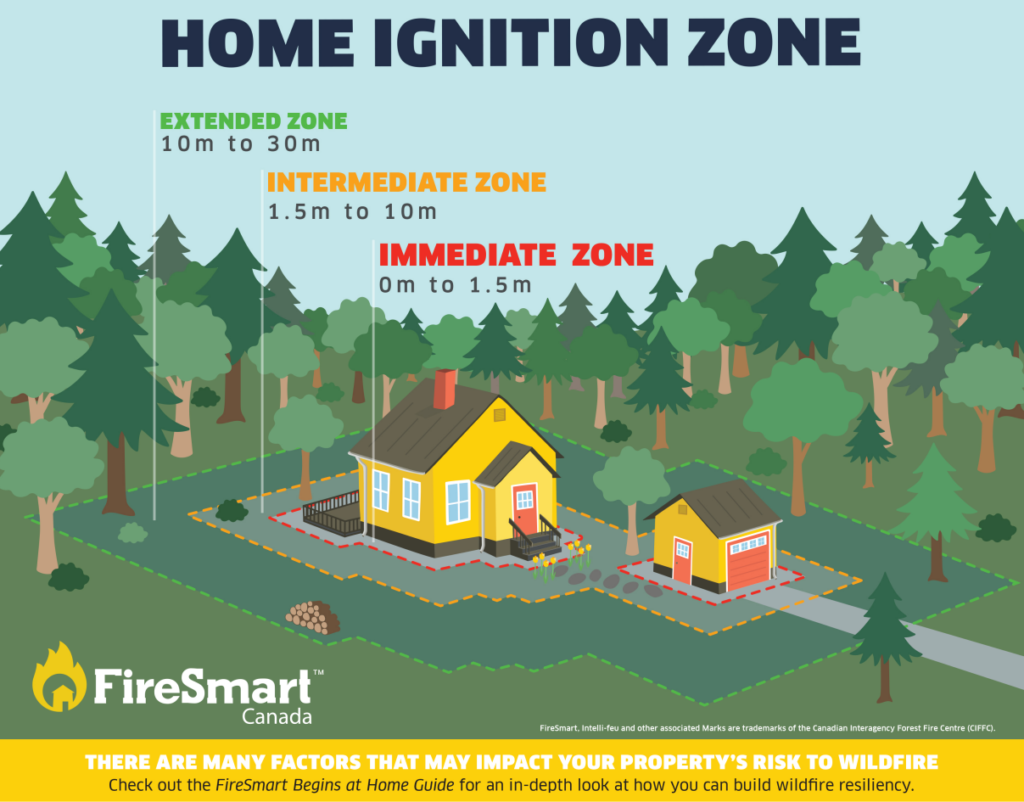
The home ignition zone has three areas: the Extended Zone 10 to 30m from your house, the Intermediate Zone 1.5 to 10m from your house, and the Immediate Zone 1.5 to 0m from your house.
How To Protect The Zones Around Your Home:
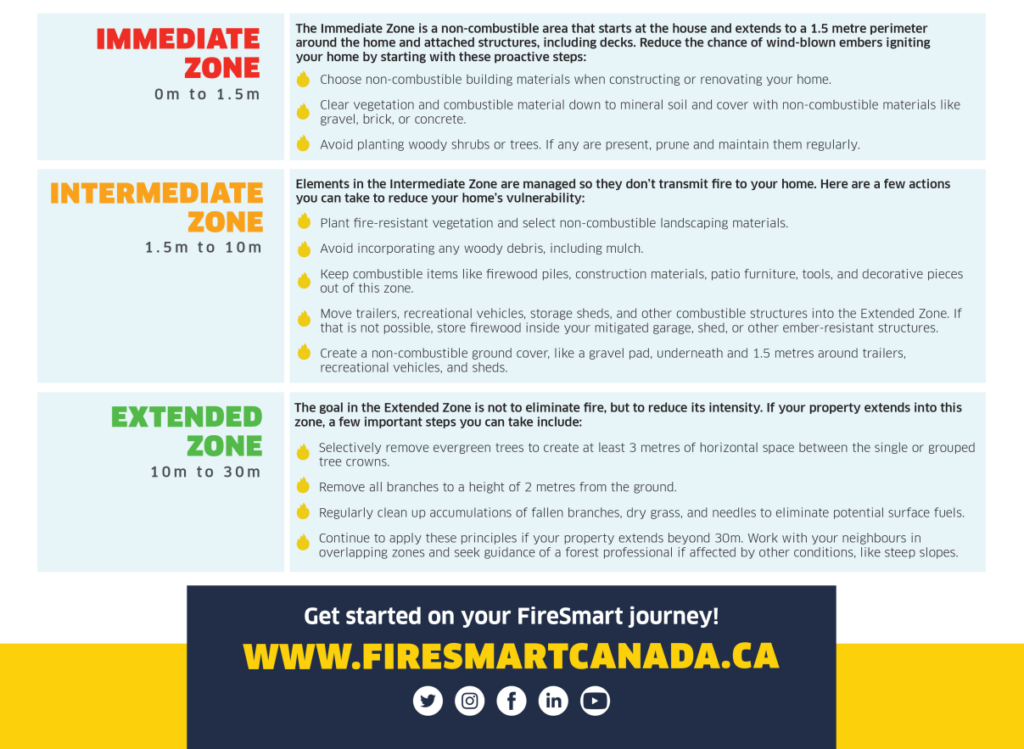
Immediate Zone:
A non-combustible area that starts at the house and extends to a 1.5 metre perimeter around the home and attached structures, including decks. Reduce the chance of wind-blown embers igniting your home by starting with these proactive steps:
- Choose non-combustible building materials when constructing or renovating your home
- Clear vegetation and combustible material down to mineral soil and cover with non-combustible materials like gravel, brick, or concrete
- Avoid planting woody shrubs or trees. If any are present, prune and maintain them regularly
Intermediate Zone:
Elements in the Intermediate Zone are managed so they don’t transmit fire to your home. Here are a few actions you can take to reduce your home’s vulnerability:
- Plant fire-resistant vegetation and select non-combustible landscaping materials
- Avoid incorporating any woody debris, including mulch
- Keep combustible items like firewood piles, construction materials, patio furniture, tools, and decorative pieces out of this zone
- Move trailers, recreational vehicles, storage sheds, and other combustible structures into the Extended Zone. If that is not possible, store firewood inside your mitigated garage, shed, or other ember-resistant structures
- Create a non-combustible ground cover, like a gravel pad, underneath and 1.5 metres around trailers, recreational vehicles, and sheds
Extended Zone:
The goal in the Extended Zone is not to eliminate fire, but to reduce its intensity. If your property extends into this zone, a few important steps you can take include:
- Selectively remove evergreen trees to create at least 3 metres of horizontal space between single or grouped tree crowns
- Remove all branches to a height of 2 metres from the ground
- Regularly clean up accumulations of fallen branches, dry grass, and needles to eliminate potential surface fuels
- Continue to apply these principles if your property extends beyond 30m. Work with your neighbours in overlapping zones and seek guidance of a forest professional if affected by other conditions, like steep slopes.